
Criminal Cases in the Summit County Courts
Summit County criminal court cases divide by offense level. The Third District Court's Silver Summit location hears all felonies and class A misdemeanors. Summit County Justice Court handles most class B and class C misdemeanors, infractions, county ordinance cases, and traffic matters. The case number begins with a two-digit filing-year prefix, but that number is not unique across Utah. A name or citation search should therefore be narrowed to Summit County and the likely court.
The clerk is the custodian of each court case file. Court staff enter the case, filings, hearings, judgment, and disposition in CORIS, the Utah Courts case-management system. Public CORIS data is then exposed through Xchange. The arresting agency's report and the jail's booking entry remain separate records. The official Summit County government site routes readers to local offices, while those tracing the full path from an arrest can use the broader Summit County arrest history process before matching the booking to a filed court case.
Summit County Court Jurisdiction
Choosing the wrong jurisdiction is one of the easiest ways to miss a Summit County criminal case. Search both District Court and Justice Court when the charge level is not known. A felony or class A allegation points to Third District Court. Most class B or class C offenses point to Summit County Justice Court. Municipal and citation routing still must be checked against the issuing court because the place of an incident does not by itself prove venue.
The local split reflects Utah's offense classes. First-, second-, and third-degree felonies carry different prison ranges, while class A misdemeanors can carry up to 364 days in jail. Class B and class C cases have lower maximum jail ranges. Those labels describe the charged level, not the outcome. Enhancements and offense-specific laws may change the baseline, and a prosecutor may amend a charge before disposition.
The county facilities plan shows why local records can feel closely linked: the Justice Center brings court, sheriff, jail, and victim-advocate functions into one secured complex. Their counters still hold different records.
How to Search Case Records
Utah Courts Xchange is the main public online channel for Summit County criminal case records. Guest payment and subscriber paths reach public docket data. Use an exact surname, a given name, and birth date when known. Add Summit County, the likely court, case type, or date range to keep a broad name from reaching the 500-result cap. Each search action can be billable, so check the filters before submitting.
- Open Xchange and choose District Court, Justice Court, or both based on the likely offense level.
- Set the search scope to Summit County or the named court, then enter the case number or party name.
- Add birth date, case type, filing period, or citation number when the first result set is too broad.
- Open the case-number link, then review the chronology, parties, hearings, and disposition rather than relying on the first charge line.
- Use the court clerk, a courthouse terminal, or the recording-request channel for a public item that Xchange does not supply online.
| Field Label | Type | Required | Notes |
|---|---|---|---|
| Jurisdiction | Selection | Unspecified | District Court, Justice Court, or both |
| Last Name/Company | Text | Conditional | Party surname or company name |
| First Name | Text | Optional | An asterisk can retrieve name variations |
| Case Number | Text | Optional | Not statewide-unique; first two digits show filing year |
| Birth Date | Date | Optional | Often available for criminal defendants |
| Case Type | Dropdown | Optional | Choose the relevant criminal category |
| Search Scope | Dropdown | Optional | Statewide, county, or a particular court |
| Date Range | Panel | Optional | Open with the Show Date Range Panel control |
The official Xchange help screens illustrate these filters and the result layout.
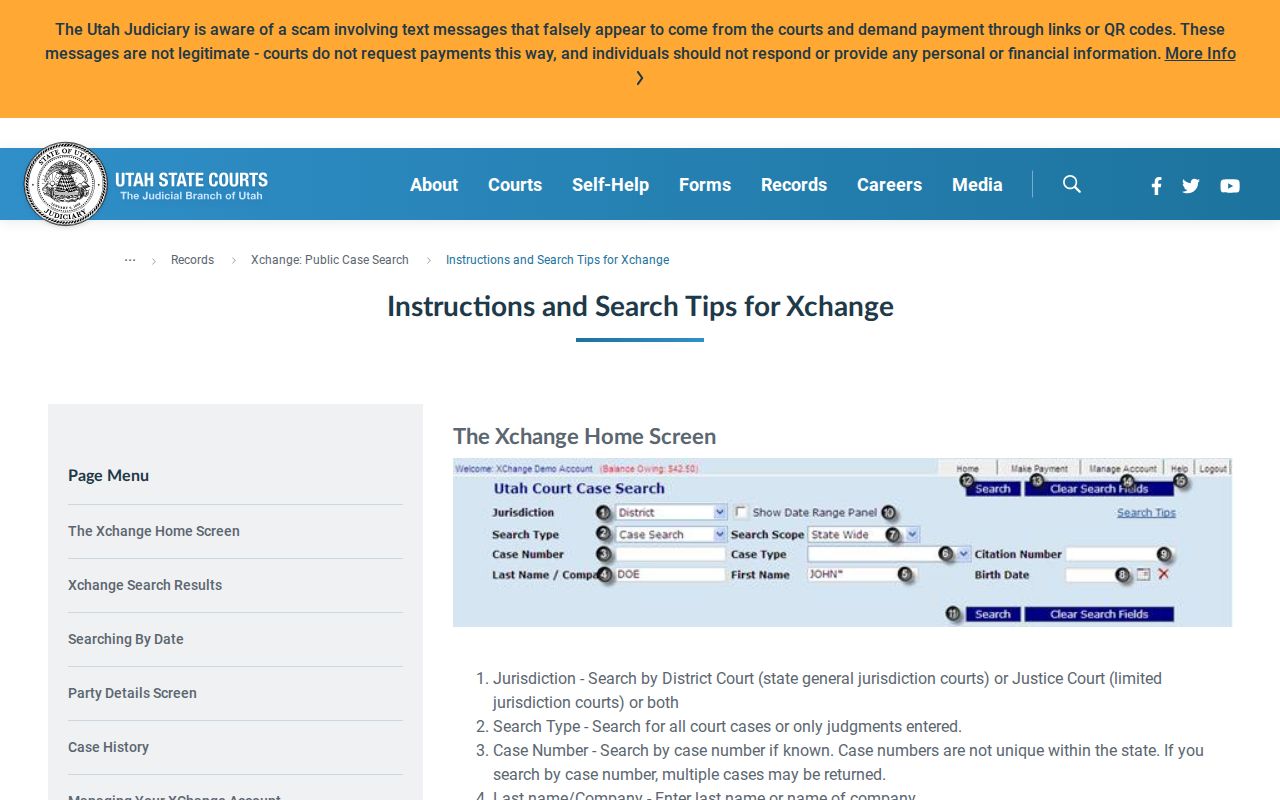
Those controls make the court, date, and identity filters just as important as the name field in a Summit County case search.
Summit County Xchange Filters
A search result identifies the county, court location, case type, case number, filing date, and party information. Birth date may appear for a criminal defendant. Open the case-number link to reach the event history. A separate Case History/Documents path can expose filings and available images. Public district-court electronic documents filed since July 1, 2010 may be available, while converted older cases can contain much less detail.
Case numbers and citations can repeat in different Utah courts. A Summit County filter prevents a locally filed number from being mistaken for a case elsewhere. Wildcards can help when a middle initial or name form varies, but they may create a large result set. If Xchange returns too many matches, add a court, criminal case type, birth date, or filing window before paying for another search.
Note: Xchange data appears after court staff enter it in CORIS, so a very new filing may require a clerk check.
What the Case File Shows
A Summit County criminal case file is centered on one prosecution. It can show the filed accusation, the people assigned to the case, each court event, public filings, the final result, and financial entries. It does not replace the arresting agency's narrative or BCI's fingerprint-linked repository record. Read the latest event and disposition before drawing a conclusion from the original charge.
| Case Number & Court | Identifies the filing year, assigned court, county, location, and case type. |
|---|---|
| Charging Document | The complaint, information, or indictment states the accusation filed with the court. |
| Docket Entries | A dated chronology lists filings, minute entries, orders, and other public events. |
| Hearing Dates | Past and scheduled proceedings appear with available court and calendar details. |
| Disposition & Judgment | The outcome may show conviction, dismissal, acquittal, plea resolution, or another result. |
| Sentence & Conditions | Public entries may state jail or prison terms, probation, fines, restitution, and related orders. |
Assigned judges, attorneys of record, public party information, and document images may also appear. A missing image does not mean the filing never existed. Ask the clerk whether the public record is available at the counter or in another approved form.
Free Summit County Court Access
Online Xchange access can involve search and document charges. Utah Courts provides a free alternative through public terminals at most district courthouses. The CORIS public-access instructions explain the terminal and clerk routes. A courthouse user can search public court information without treating the paid web portal as the only way into a Summit County docket.
The official courthouse-access page shows how the free terminal option complements Xchange.
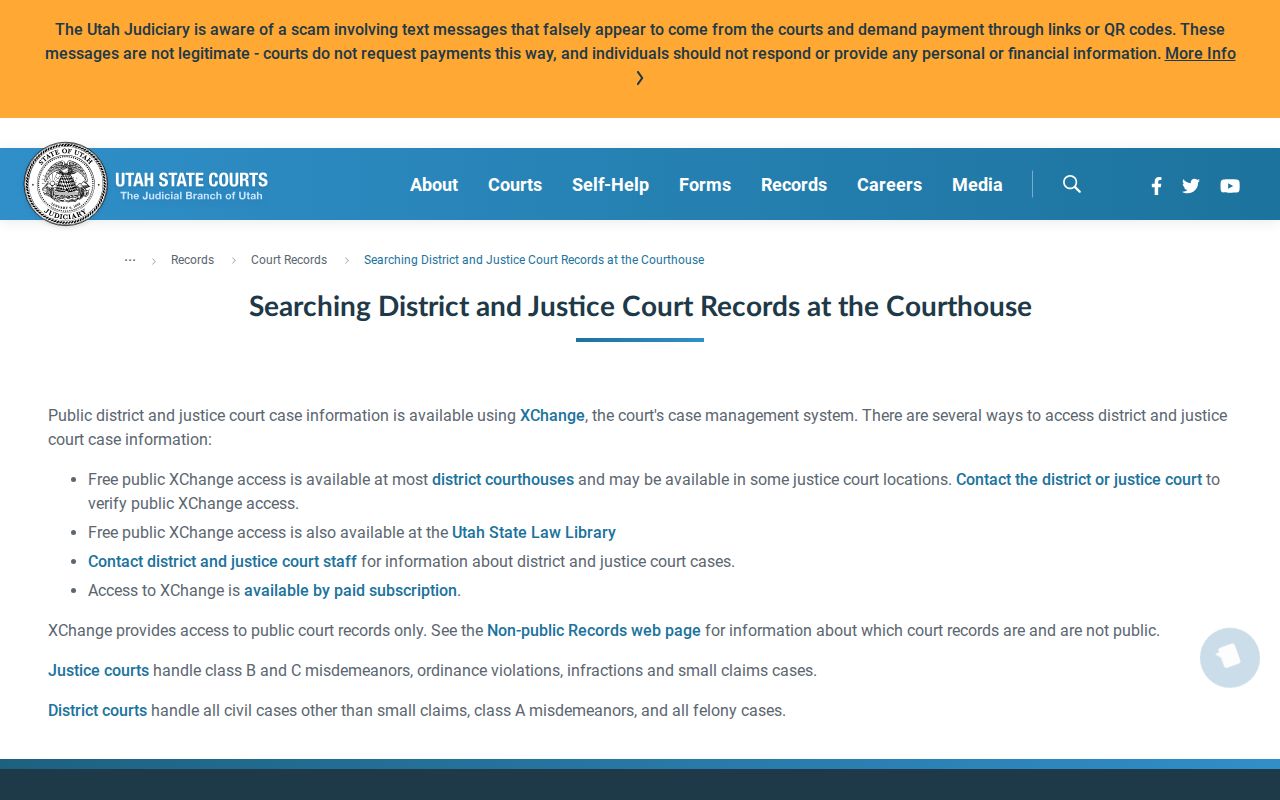
The terminal is useful when a name search needs repeated refinement or an online payment path is not practical.
For an electronic hearing recording, identify the court and hearing before emailing the designated Summit County contact at jodim@utcourts.gov. The Utah Courts recording instructions explain that request workflow. Certified copies and nonpublic material require separate clerk review.
Stages of a Criminal Case
A Summit County court file begins when a prosecutor files a complaint or information, or when an indictment is filed. Arraignment addresses the charge and plea. Pretrial events can include motions, evidence issues, scheduling, and negotiations. A plea or trial then leads toward a disposition. If guilt is established, the court enters judgment and proceeds to sentencing. Time varies with the facts, filings, calendars, and whether the case resolves by plea or trial.
Case flow: Charges Filed › Arraignment › Pretrial › Plea or Trial › Disposition › Sentencing
The docket should be read in that order. An information is a charging paper, not a finding of guilt. A dismissal ends a charge without conviction. An acquittal is a not-guilty result. A disposition is the outcome, while the sentence states the consequence imposed after a conviction.
Reading Summit County Dispositions
Charge and disposition answer different questions. The charge says what the state alleged. The disposition says how that allegation ended. In a Summit County case, separate counts can reach different outcomes. One count may be dismissed while another results in a plea or judgment. The original charge list should never be quoted as though every count became a conviction.
- Disposition
- The recorded outcome of a case or charge.
- Plea in abeyance
- A plea held under set conditions and potentially dismissed after compliance.
- Dismissal
- A charge ended without a conviction.
- Acquittal
- A not-guilty result after the court process.
- Sentence
- The court-ordered consequence following a judgment of guilt.
Use the official Utah case-type definitions when an Xchange code is unclear. A code describes the case category, while event text and the final disposition provide the result. If a bench warrant appears in the chronology, the Summit County Justice Court warrant guidance directs readers to verify current status by phone because it changes quickly.
Access & Restrictions
Utah law allows inspection of public court records, but access has limits. Xchange excludes sealed, expunged, and juvenile cases. Victim details, private personal data, medical facts, protected investigative material, and security information may also be withheld or redacted. The public web view may contain less than the clerk's file because a public paper or electronic item is not always displayed as an online image.
Utah Code §63G-2-201 sets the public-record inspection framework. Court-record classification also follows Judicial Administration Rule 4-202.02. These rules permit public access while protecting records classified as nonpublic.
If a known Summit County criminal case does not appear, confirm the name, court, and year first. Then ask the clerk whether the matter is restricted, too old for a complete converted file, not yet entered, or held in another form. Older judicial records may have moved to Utah State Archives. A public terminal or clerk inquiry can resolve an online gap without assuming the case vanished.
Note: Expungement removes a qualifying case from public inspection but does not mean every government record was physically destroyed.
MyCourtCase for Summit County Parties
MyCourtCase is the party-only route for an eligible Utah case. It is free, but it is not a public name-search tool. Registration requires an email address, case number, and government-issued identification. Once the identity and party relationship are confirmed, the account can show case history and filed papers, accept payments, and provide other case-specific functions.
The official MyCourtCase page shows the account features and identity steps used by a Summit County party.
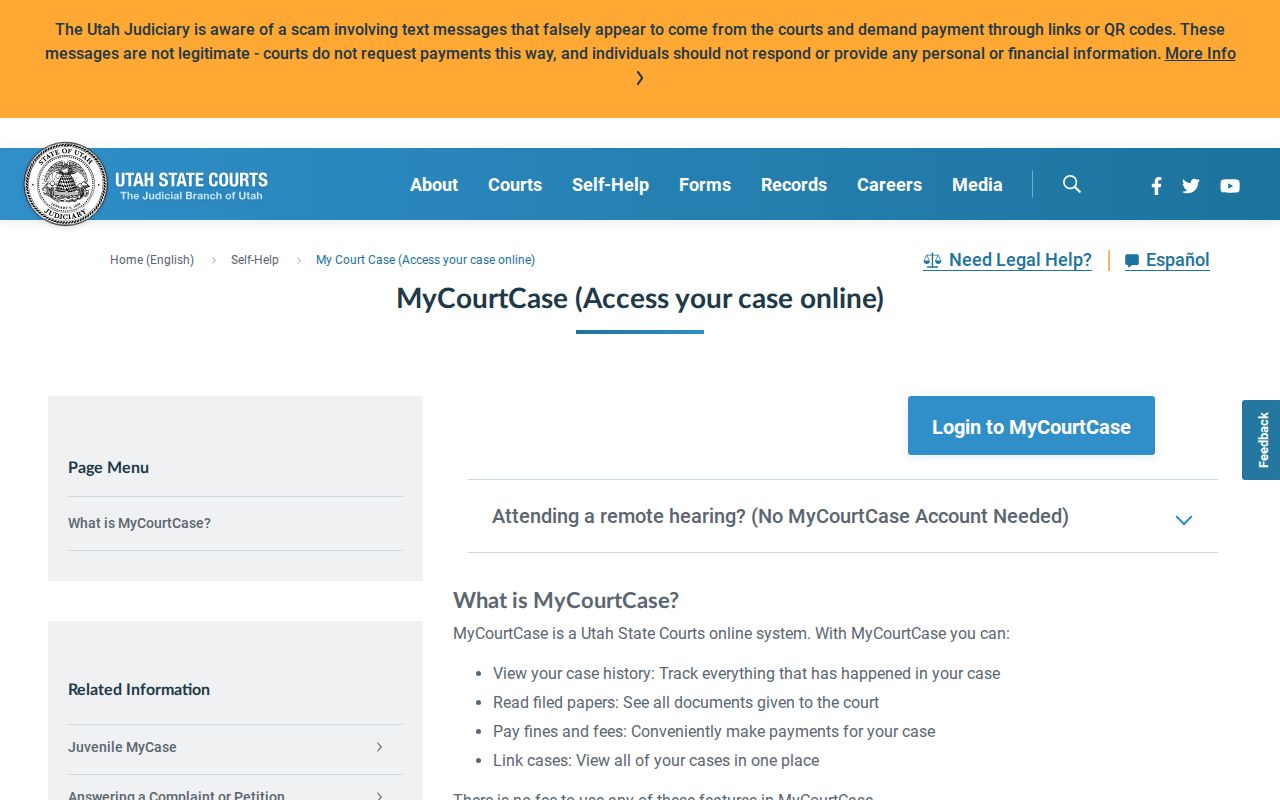
This split is deliberate: Xchange serves public court research, while MyCourtCase lets a verified party work with their own eligible file.
Neither system is a BCI rap sheet. The Utah Department of Public Safety Bureau of Criminal Identification uses a subject-only Right of Access process for a person's own statewide repository history. A court docket remains case-centered, so it may show filings and outcomes that serve a different need than BCI's fingerprint-linked arrest cycles.